Every company learned to “go live” in 2020. Very few learned to go live well. Six years later, the bar has moved: your audience watches broadcast-quality content all day, and a shaky webcam feed with laptop audio doesn’t read as scrappy anymore — it reads as careless.
Here’s what production-grade live streaming actually involves, what it costs, and when it pays for itself.
Why “Good Enough” Streaming Quietly Costs You
Live streaming is the highest-stakes content format a business can publish. A blog post can be edited after launch. A stream fails in front of everyone, in real time, with your logo in the corner.
And the stakes compound because live formats now carry real revenue weight: product launches, investor updates, paid virtual conferences, hybrid summits, town halls for distributed teams, live commerce, and training programs. Industry estimates consistently show that video — and live video in particular — holds attention several times longer than static formats, and viewers routinely cite production quality as a top reason for dropping off a stream within the first minutes.
Translation: the production layer isn’t a cost center. It’s the retention mechanism.
The Anatomy of a Professional Live Production
What separates a production-grade stream from a webcam call isn’t one big thing — it’s a stack of unglamorous decisions made correctly.
Signal chain: cameras, audio, and switching
- Multi-camera setup. Two cameras is the professional minimum (a wide and a close-up); three to four unlocks proper visual storytelling — speaker, audience, screen content, and detail shots. Cutting between angles is what makes 45 minutes feel like 15.
- Audio first, always. Viewers forgive soft focus; they never forgive bad audio. Dedicated microphones per speaker, a proper mixer, and a crew member who owns sound. If your budget forces a choice between a better camera and better audio, choose audio.
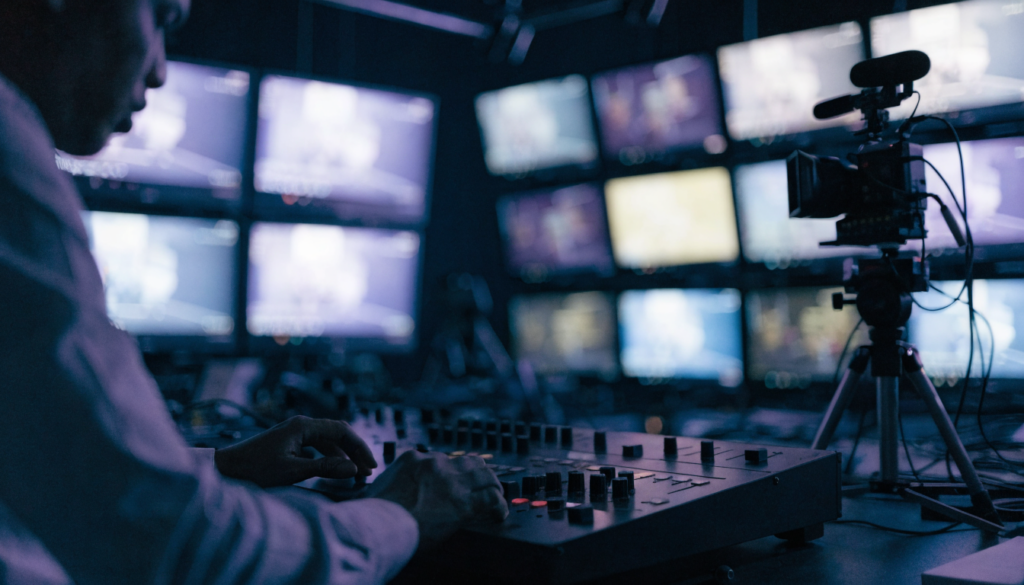
- Live switching and graphics. A vision mixer, lower thirds, branded overlays, pre-produced openers and transitions, and clean handling of slides or screen shares. This is where “stream” becomes “broadcast.”
Encoding and redundancy: the invisible 50%
- Dedicated bandwidth. Never stream over shared venue Wi-Fi. A hardwired line with an upload capacity of at least 3–4x your stream bitrate is the baseline; bonded cellular as backup.
- Redundant encoding. Primary and backup encoders, ideally on separate power. Professional productions assume failure and design around it.
- A rehearsal. A full technical run-through at the actual venue, on the actual connection, with the actual presenters. In our experience, rehearsals surface the majority of would-be live failures — cheap insurance against the most expensive kind of mistake.
Crew: the part diagrams leave out
A realistic professional crew for a business stream: director/vision mixer, camera operators, audio engineer, streaming/encoding technician, and a producer running the show flow. For smaller formats, roles combine — but someone must own each function. The most common failure mode in corporate streaming is one overloaded person owning all five.
Platform Strategy: Where and How to Distribute
The right platform mix depends on who you’re trying to reach:
- LinkedIn Live / YouTube for public-facing thought leadership, launches, and investor communication.
- Multistreaming — pushing simultaneously to multiple platforms — maximizes reach for public events, with per-platform encoding so each feed looks native.
- Private/gated streaming (embedded players, registration walls, secure links) for paid events, internal town halls, and anything with confidentiality requirements.
- Twitch and community platforms when your audience skews younger or gaming-adjacent — a natural fit if you’re already exploring esports formats.
One strategic note: the live moment is only half the asset. A properly produced stream yields a content library — cut-downs for social, a highlight reel, an on-demand replay, quote clips for sales. Plan the post-production harvest before you go live, and one event becomes a month of content.
What Does It Cost? Honest Ranges
Every project is different, but as directional estimates for the European market:
- Compact single-location production (2 cameras, graphics, one platform): typically low four figures per event day.
- Full multi-camera broadcast (3–5 cameras, switching, redundant encoding, multistream, full crew): mid four to five figures depending on scale and venue complexity.
- Multi-day or multi-venue productions (conferences, hybrid summits, tournament broadcasts): scoped individually — this is where a production partner earns their fee in logistics alone.
The comparison that matters isn’t stream vs. no stream. It’s the cost of production vs. the cost of a failed or forgettable live moment in front of your most engaged audience. If you’re planning an event with both an in-room and remote audience, the calculus shifts again — we’ve covered that in our guide to hybrid event broadcasting.
How Venture CO Group Helps
Live streaming sits at the center of what Venture CO Group’s motion picture division does: recording, editing, streaming, and broadcasting as one integrated service. We bring the full stack — multi-camera setups, live switching, branded graphics, redundant encoding, platform distribution — and the crew that has run it under pressure, from corporate broadcasts to full esports tournament productions across the EU, UK, US, Turkey, and Uzbekistan.
And because the group also houses marketing and IT services, we don’t stop at the signal. We help you build the registration funnel, promote the stream, capture the leads, and turn the recording into a content pipeline.
Go Live Like You Mean It
Your next launch, summit, or town hall deserves better than “good enough.” Tell us what you’re planning and we’ll scope the production that fits it.
Get a production quote → https://ventureco.group/enquiry/