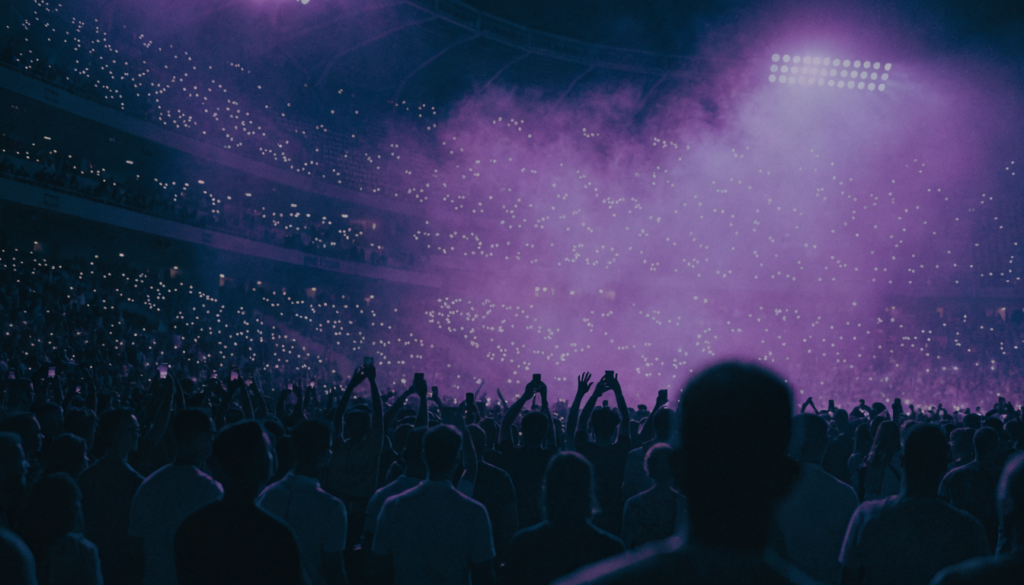
Your venue holds 300 people. Your audience is 30,000. That gap is either a hard ceiling on your event’s impact — or, with proper hybrid event broadcasting, its single biggest growth lever.
Most hybrid events fail the same way: the organizer builds a great in-room experience, then points a camera at it and calls the remote feed done. Remote attendees get a static wide shot, muddy audio, and the distinct feeling of watching someone else’s party through a window. They leave, and they don’t register next year.
Done right, hybrid isn’t an event plus a stream. It’s one event with two front rows.
The Hybrid Dividend: Why the Broadcast Layer Pays
Before the how, the why — because hybrid production is an investment and it should be justified like one.
- Reach without venue math. Your physical capacity is fixed by fire code. Your broadcast capacity isn’t. A well-promoted hybrid event can realistically multiply total attendance several times over the in-room count — and the remote audience costs you catering for exactly nobody.
- Sponsorship inventory doubles. A hybrid event gives sponsors both on-site placement and broadcast integration: branded segments, overlays, sponsored replays, digital booths. More inventory, more measurable impressions, stronger renewal case.
- Content compounding. Every properly broadcast session becomes an on-demand asset. As a rule of thumb, a two-day conference produced at broadcast quality yields 20–40 reusable content pieces — session replays, highlight reels, speaker clips, social cut-downs.
- Geography stops filtering your audience. Speakers, buyers, and press who would never fly in can attend in one click. For companies operating across markets — say, the EU, UK, US, Turkey, and Uzbekistan — this isn’t a nice-to-have; it’s the only way one event serves all of them.
Design for Two Audiences From Day One
The core discipline of hybrid: the remote audience is a first-class audience, not an afterthought. That principle changes decisions across the whole event.
Program design
- Pace for the screen. In-room attendees tolerate a 60-minute panel; remote viewers rarely do. Tighten sessions, insert breaks, and design transitions that work on camera — pre-produced bumpers, host segments, sponsor moments.
- Give remote attendees jobs. Live Q&A that actually gets answered on stage, polls whose results appear on the venue screens, chat moderation with a real human. When the room reacts to something remote attendees did, the window becomes a door.
- A broadcast host. The single highest-leverage hybrid hire. Someone who speaks to the camera between sessions, frames what’s coming, and makes remote viewers feel addressed rather than tolerated.
Production design
Treat the broadcast as a TV production that happens to have a live studio audience:
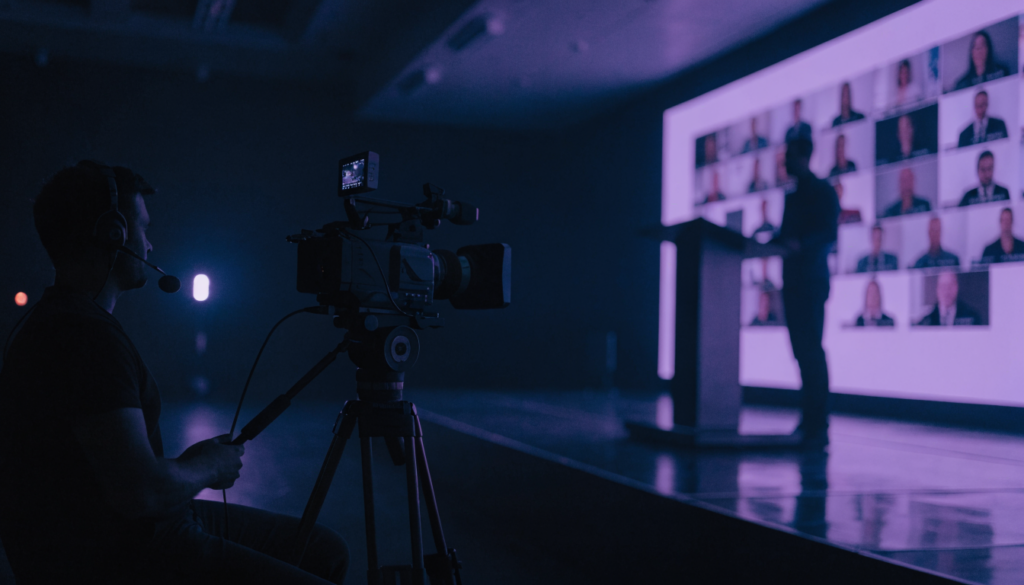
- Multi-camera coverage — speaker close-ups, wides, audience reactions, and clean feeds of slides. Three cameras is a practical minimum for a professional conference broadcast; more for multi-stage events.
- Dedicated broadcast audio — a feed from the sound desk, never room microphones. This one decision separates professional hybrid events from painful ones.
- Graphics and identity — branded overlays, speaker lower thirds, session titles, sponsor integrations. The remote experience should look designed, because it is.
- Redundancy — dedicated uplink, backup encoder, backup connectivity. A hybrid event’s remote half can fail totally from one network hiccup; production-grade setups assume it and route around it.
The Technical Backbone: What Actually Has to Work
A realistic hybrid broadcasting stack, layer by layer:
- Capture — cameras, audio desk feed, presentation capture from every stage.
- Production — vision mixing, graphics insertion, replay capability, and a director cutting the show in real time.
- Encoding and transport — redundant encoders pushing over a dedicated line (plan 3–4x your bitrate in upload capacity), with bonded cellular backup.
- Distribution — public platforms (YouTube, LinkedIn Live) for reach, or gated event platforms for ticketed access, or both simultaneously with separate feeds.
- Interaction layer — Q&A, polling, chat, and networking tools wired into the show flow, not bolted on.
- Measurement — concurrent viewers, watch time per session, drop-off points, interaction rates, and lead capture. Hybrid events are the most measurable events you can run; instrument accordingly.
And one non-negotiable: a full technical rehearsal on-site, on the real network, before doors open. Most of what goes wrong in hybrid events is discoverable 24 hours earlier — if anyone looks. (For a deeper dive into the streaming layer itself, see our production-grade guide to live streaming for business.)
Budgeting Hybrid Honestly
Directional estimates: adding a professional broadcast layer to an existing conference typically adds 20–40% to the production budget, scaling with camera count, stage count, and platform complexity. Set that against the arithmetic above — multiplied reach, doubled sponsor inventory, and a year of content — and hybrid broadcasting is usually the cheapest audience you’ll ever acquire. The expensive version of hybrid is the one done badly twice.
How Venture CO Group Helps
Hybrid events sit exactly at the intersection of what Venture CO Group was built for. Our motion picture team handles recording, live editing, streaming, and broadcasting; our event production crews — hardened by esports productions, the most technically unforgiving live format there is — run staging, networks, and redundancy; and our marketing side builds the promotion, registration funnel, and post-event content engine.
One partner, one accountable team, from the first site survey to the post-event report. We’ve delivered productions across the EU, UK, US, Turkey, and Uzbekistan since 2019.
Make the Venue Your Smallest Audience
If your next conference, summit, or launch deserves more than the people who can physically get there, let’s design the broadcast layer together.
Plan your hybrid event → https://ventureco.group/enquiry/