Here’s an experiment you’ve already run without noticing. Open LinkedIn. Scroll for sixty seconds. Count what actually stopped your thumb. Odds are, it moved — a clip, a talking head, a product demo, a stream highlight.
That’s not a coincidence. It’s the market telling you, in real time, what a video marketing strategy 2026 needs to accept as its starting premise: attention now defaults to motion. Text and static design still have jobs to do — but they’re supporting cast. Video is the lead.
The Case in Numbers (the Honest Version)
Let’s use estimates responsibly, because the direction matters more than any single stat:
- Video has accounted for a large majority of consumer internet traffic for years — commonly estimated north of 80% — and B2B buyer behavior has followed consumer behavior on every platform shift so far.
- Viewers retain dramatically more of a message delivered in video than in text; commonly cited estimates put video message retention at multiples of reading.
- The buyers who now hold budgets — Millennials and Gen Z — grew up on YouTube and short-form. Surveys of younger B2B buyers consistently show a strong preference for watching a product explanation over reading one.
- Platforms structurally reward it: LinkedIn, Instagram, TikTok, and YouTube all weight native video in distribution, which means video gets organic reach that text formats increasingly have to pay for.
None of these numbers need to be precise for the conclusion to hold: in 2026, brands that can’t communicate in motion are opting out of where attention lives.
What “Video-First” Actually Means (and Doesn’t)
Video-first doesn’t mean “make a brand film once a year.” It means video is the native format of your marketing engine, with other formats derived from it. In practice, a working stack has four layers:
1. Short-form: the attention layer
15–60 second clips built for feeds — founder takes, sharp opinions, product moments, behind-the-scenes. This is your reach engine. The bar is authenticity and pace, not cinema. Volume matters: think weekly rhythm, not quarterly campaign.
2. Mid-form: the trust layer
2–10 minute pieces — product walkthroughs, customer conversations, expert explainers. This is where a buyer decides whether you actually know your subject. It’s also the single best source material for the multiplication model: one strong mid-form video yields clips, an article, stills, and email content. (We break that repurposing math down in our piece on turning a blog into a revenue channel.)
3. Live and streamed: the presence layer
Webinars, live launches, hybrid events, streamed panels. Live formats convert attention into interaction — questions, chat, real-time objection handling. Esports production taught the industry what “good live” looks like: multi-camera setups, real-time graphics, an actual show rather than a screenshare with a pulse. Audiences now expect that standard everywhere, including B2B.
4. Flagship: the authority layer
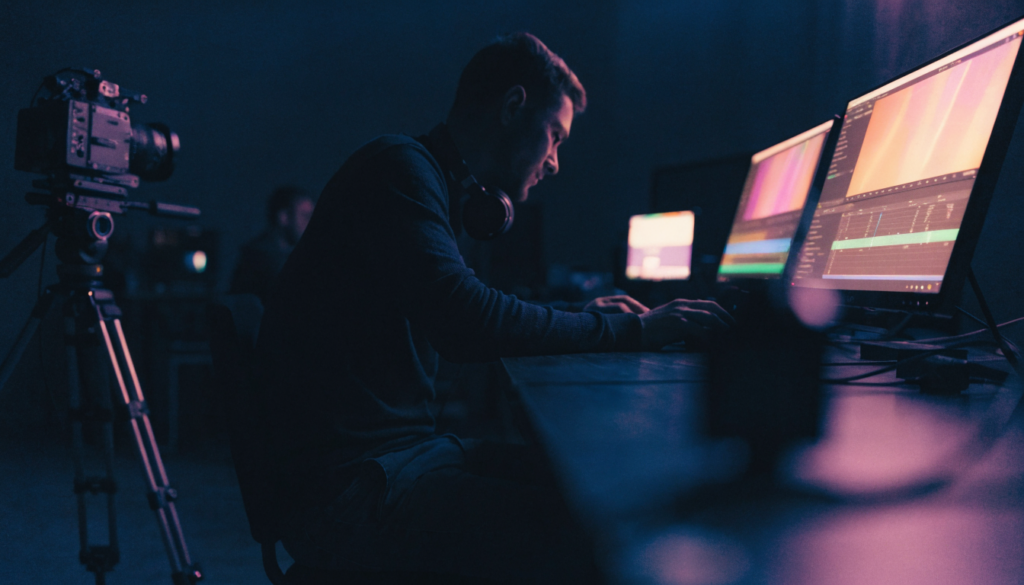
The one or two properly produced pieces per year — a brand film, a documentary-style customer story, an event aftermovie — where full motion picture craft (cinematography, editing, sound design, color) earns its budget. These are the assets that make a mid-size company look like a category leader.
Most companies fail by living in only one layer: all polished flagship and no feed presence, or all shaky selfie clips and no substance. The layers work as a system.
The Three Mistakes That Kill Video ROI
- Producing without a distribution plan. A video that lives only on your homepage is a very expensive screensaver. Every piece needs a platform-native cut: vertical for feeds, captioned by default (a majority of feed video is watched muted — plan for it), thumbnailed for YouTube.
- Confusing production value with production fit. A CEO hot-take shot on a phone can outperform a €30k brand film — in the feed. The same phone clip would embarrass you at a flagship event. Match craft to context; don’t apply one standard everywhere.
- Treating video as a campaign instead of a capability. One-off videos produce one-off results. The compounding returns come from a pipeline: recurring formats, a consistent visual system (yes, your design system should include motion rules), and a capture-everything mindset at every event you run or attend.
Where to Start If You’re Starting From Zero
A realistic first 90 days, in order of leverage:
- Audit what you already have — event footage, webinar recordings, screen demos. Most companies are sitting on unedited gold.
- Launch one recurring mid-form format — a monthly expert conversation or product deep-dive. Consistency beats ambition.
- Clip everything — every mid-form piece becomes 3–5 shorts, on a schedule.
- Film your next event properly — one well-captured event can feed a quarter of content. One badly captured event feeds nothing, forever.
Budget honestly: a sustainable video engine is an operating expense like any channel, not a one-time splurge — and it’s cheaper than most teams assume once repurposing is factored in.
How Venture CO Group Helps
Video-first only works when strategy, production, and distribution are one loop — and that’s exactly how Venture CO Group is built. Our motion picture team handles recording, editing, streaming, and broadcasting; our esports event production arm delivers broadcast-grade live shows; our marketing and design teams turn every shoot into a multi-format campaign; and our saleshouse can put the resulting attention directly into your sales calendar.
One brief, one team, from camera to closed deal — across the EU, UK, US, Turkey, and Uzbekistan.
The Feed Won’t Wait
Every quarter without a video engine, your competitors’ faces get more familiar to your buyers than yours. Attention compounds for whoever shows up.
Ready to go video-first without hiring a studio, an agency, and a producer separately? Let’s talk →